Introduction
Thanks to the soundworks JavaScript framework and the dotpi-tools developed during the DOTS research program, one can easily control a fleet of nano-computers over the network (i.e. Raspberry Pi). Powered by external power banks and equipped with amplifiers, these objects turn into distributed autonomous speakers. Moreover, thanks to the node-web-audio-api these objects are able to compute and synthesize sound controlled in real-time through the network in a straightforward workflow using web technologies.
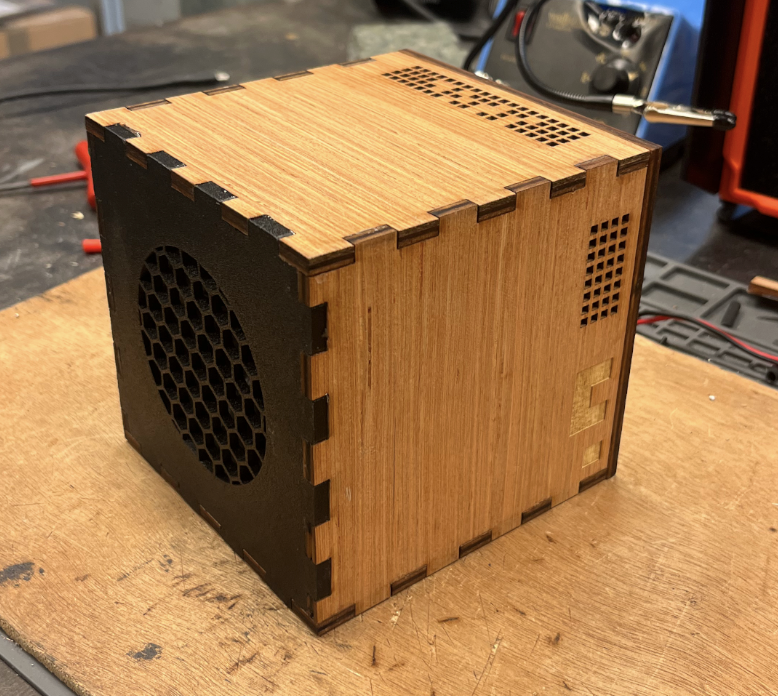
Why
From a software point of view, taking into account the tools mentioned above, we have access to all the required technologies to build a distributed audio system.
Some of the benefits of such systems include portability, ease of deployment and optimization among other things. From this point of view, it is not desirable to have all the necessary equipment broken down into many different parts which would lead into a tedious process of setting up and operating the system.
This tutorial aims to guide you into building speakers adapted to distributed musical systems.
Approximate time
Because it depends on how fast you and your machines are, the time needed to manufacture a box is variable. Furthermore, there are lulls in the process, such as glue drying times, 3D printing and laser cutting.
To give an idea of the scale, you should allow about 5 days in order to build 4 speakers.
Related documentation an tutorials
soundworks
Open-source creative coding framework for distributed applications based on Web technologies.
Web Audio API
A powerful and versatile system for controlling audio on the Web, allowing developers to choose audio sources, add effects to audio, create audio visualizations, apply spatial effects (such as panning) and much more.
The Web Audio API has been ported to the Node.js environment:
dotpi ecosystem
The dotpi ecosystem aims at facilitating the creation and maintenance of a fleet of Raspberry Pi nano-computers to run distributed audio applications.
Alternatives
Such systems have already been explored and developed, such as the PrÉ devices for example